> ## Documentation Index
> Fetch the complete documentation index at: https://docs.bytebot.ai/llms.txt
> Use this file to discover all available pages before exploring further.
# Desktop Environment
> The virtual Linux desktop where Bytebot performs tasks
## Overview
The Bytebot Desktop Environment (also called Bytebot Core) is a complete Linux desktop that runs in a Docker container. This is where Bytebot does its work - clicking buttons, typing text, browsing websites, and using applications just like you would.
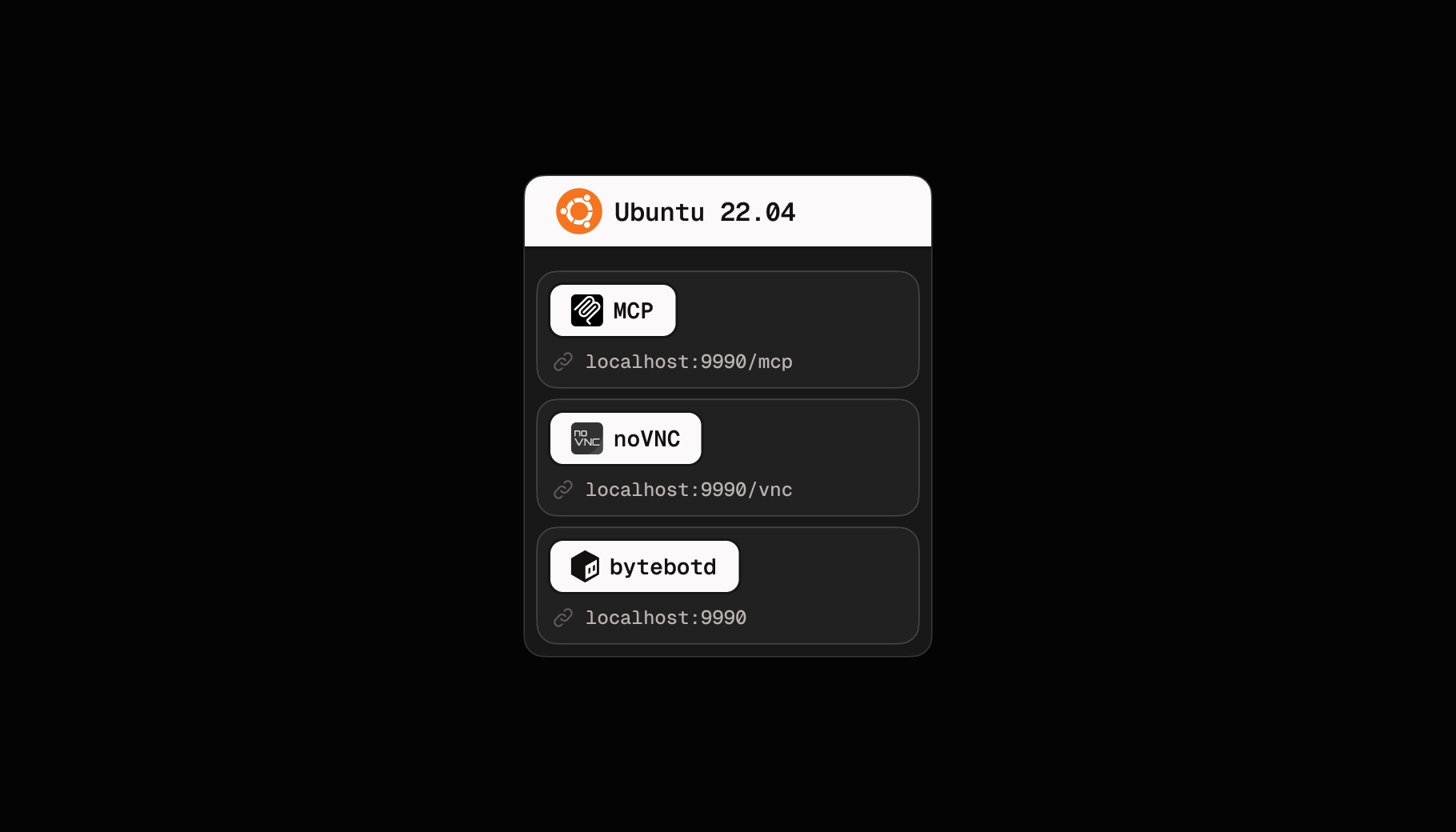 ## Why a Virtual Desktop?
### Complete Isolation
* **No Risk to Host**: All actions happen inside the container
* **Sandboxed Environment**: Desktop can't access your host system
* **Easy Reset**: Destroy and recreate in seconds
* **Clean Workspace**: Each restart provides a fresh environment
### Consistency Everywhere
* **Platform Independent**: Same environment on Mac, Windows, or Linux
* **Reproducible**: Identical setup every time
* **Version Control**: Pin specific versions for stability
* **No Dependencies**: Everything included in the container
### Built for Automation
* **Predictable UI**: Consistent element positioning
* **Clean Environment**: No popups or distractions
* **Automation-Ready**: Optimized for programmatic control
* **Fast Startup**: Desktop ready in seconds
## Technical Stack
### Base System
* **Ubuntu 22.04 LTS**: Stable, well-supported Linux distribution
* **XFCE4 Desktop**: Lightweight, responsive desktop environment
* **X11 Display Server**: Standard Linux graphics system
* **supervisord**: Service management
### Pre-installed Software
* Firefox ESR (Extended Support Release)
* Pre-configured for automation
* Clean profile without distractions
* Text editor
* Office tools
* PDF viewer
* File manager
* Thunderbird email client
* Terminal emulator
* 1Password password manager
* Visual Studio Code (VSCode)
* Git version control
* Python 3 environment
### Core Services
1. **bytebotd Daemon**
* Runs on port 9990
* Handles all automation requests
* Built on nutjs framework
* Provides REST API
2. **noVNC Web Client**
* Browser-based desktop access
* No client installation needed
* WebSocket proxy included
3. **Supervisor**
* Process management
* Service monitoring
* Automatic restarts
* Log management
## Desktop Features
### Display Configuration
```bash theme={null}
# Resolution
1920x1080 @ 24-bit color
```
### User Environment
* **Username**: `user`
* **Home Directory**: `/home/user`
* **Sudo Access**: Yes (passwordless)
* **Desktop Session**: Auto-login enabled
### File System
```
/home/user/
├── Desktop/ # Desktop shortcuts
├── Documents/ # User documents
├── Downloads/ # Browser downloads
├── .config/ # Application configs
└── .local/ # User data
```
## Accessing the Desktop
### Web Browser (Recommended)
Navigate to `http://localhost:9990/vnc` for instant access:
* No software installation required
* Works on any device with a browser
* Supports touch devices
* Clipboard sharing
### MCP Control
The core container also exposes an [MCP](https://github.com/rekog-labs/MCP-Nest) endpoint.
Connect your MCP client to `http://localhost:9990/mcp` to invoke these tools over SSE.
```json theme={null}
{
"mcpServers": {
"bytebot": {
"command": "npx",
"args": [
"mcp-remote",
"http://127.0.0.1:9990/mcp",
"--transport",
"http-first"
]
}
}
}
```
### Direct API Control
Most efficient for automation:
```bash theme={null}
# Take a screenshot
curl -X POST http://localhost:9990/computer-use \
-H "Content-Type: application/json" \
-d '{"action": "screenshot"}'
# Move mouse
curl -X POST http://localhost:9990/computer-use \
-H "Content-Type: application/json" \
-d '{"action": "move_mouse", "coordinate": {"x": 500, "y": 300}}'
```
## Customization
### Adding Software
Create a custom Dockerfile:
```dockerfile theme={null}
FROM ghcr.io/bytebot-ai/bytebot-desktop:edge
# Install additional packages
RUN apt-get update && apt-get install -y \
slack-desktop \
zoom \
your-custom-app
# Copy configuration files
COPY configs/ /home/user/.config/
```
## Performance Optimization
### Resource Allocation
```yaml theme={null}
# Recommended settings
deploy:
resources:
limits:
cpus: '2'
memory: 4G
reservations:
cpus: '1'
memory: 2G
```
## Security Hardening
Default configuration prioritizes ease of use. For production, apply these security measures:
### Essential Security Steps
1. **Change Default Passwords**
```bash theme={null}
# Set user password
passwd bytebot
```
2. **Limit Network Access**
```yaml theme={null}
# Whitelist specific domains
environment:
- ALLOWED_DOMAINS=company.com,trusted-site.com
# Or restrict to local network only
ports:
- "10.0.0.0/8:9990:9990"
```
## Troubleshooting
Check logs:
```bash theme={null}
docker logs bytebot-desktop
```
Common issues:
* Insufficient memory
* Port conflicts
* Display server errors
Monitor resources:
```bash theme={null}
docker stats bytebot-desktop
```
Solutions:
* Increase memory allocation
* Check disk space
* Update container image
## Best Practices
1. **Regular Updates**: Keep the base image updated for security patches
2. **Persistent Storage**: Mount volumes for important data
3. **Backup Configurations**: Save customizations outside the container
4. **Monitor Resources**: Track CPU/memory usage
5. **Clean Temporary Files**: Periodic cleanup for performance
## Next Steps
Deploy your first agent
Control the desktop programmatically
Add AI capabilities
Set up authentication
## Why a Virtual Desktop?
### Complete Isolation
* **No Risk to Host**: All actions happen inside the container
* **Sandboxed Environment**: Desktop can't access your host system
* **Easy Reset**: Destroy and recreate in seconds
* **Clean Workspace**: Each restart provides a fresh environment
### Consistency Everywhere
* **Platform Independent**: Same environment on Mac, Windows, or Linux
* **Reproducible**: Identical setup every time
* **Version Control**: Pin specific versions for stability
* **No Dependencies**: Everything included in the container
### Built for Automation
* **Predictable UI**: Consistent element positioning
* **Clean Environment**: No popups or distractions
* **Automation-Ready**: Optimized for programmatic control
* **Fast Startup**: Desktop ready in seconds
## Technical Stack
### Base System
* **Ubuntu 22.04 LTS**: Stable, well-supported Linux distribution
* **XFCE4 Desktop**: Lightweight, responsive desktop environment
* **X11 Display Server**: Standard Linux graphics system
* **supervisord**: Service management
### Pre-installed Software
* Firefox ESR (Extended Support Release)
* Pre-configured for automation
* Clean profile without distractions
* Text editor
* Office tools
* PDF viewer
* File manager
* Thunderbird email client
* Terminal emulator
* 1Password password manager
* Visual Studio Code (VSCode)
* Git version control
* Python 3 environment
### Core Services
1. **bytebotd Daemon**
* Runs on port 9990
* Handles all automation requests
* Built on nutjs framework
* Provides REST API
2. **noVNC Web Client**
* Browser-based desktop access
* No client installation needed
* WebSocket proxy included
3. **Supervisor**
* Process management
* Service monitoring
* Automatic restarts
* Log management
## Desktop Features
### Display Configuration
```bash theme={null}
# Resolution
1920x1080 @ 24-bit color
```
### User Environment
* **Username**: `user`
* **Home Directory**: `/home/user`
* **Sudo Access**: Yes (passwordless)
* **Desktop Session**: Auto-login enabled
### File System
```
/home/user/
├── Desktop/ # Desktop shortcuts
├── Documents/ # User documents
├── Downloads/ # Browser downloads
├── .config/ # Application configs
└── .local/ # User data
```
## Accessing the Desktop
### Web Browser (Recommended)
Navigate to `http://localhost:9990/vnc` for instant access:
* No software installation required
* Works on any device with a browser
* Supports touch devices
* Clipboard sharing
### MCP Control
The core container also exposes an [MCP](https://github.com/rekog-labs/MCP-Nest) endpoint.
Connect your MCP client to `http://localhost:9990/mcp` to invoke these tools over SSE.
```json theme={null}
{
"mcpServers": {
"bytebot": {
"command": "npx",
"args": [
"mcp-remote",
"http://127.0.0.1:9990/mcp",
"--transport",
"http-first"
]
}
}
}
```
### Direct API Control
Most efficient for automation:
```bash theme={null}
# Take a screenshot
curl -X POST http://localhost:9990/computer-use \
-H "Content-Type: application/json" \
-d '{"action": "screenshot"}'
# Move mouse
curl -X POST http://localhost:9990/computer-use \
-H "Content-Type: application/json" \
-d '{"action": "move_mouse", "coordinate": {"x": 500, "y": 300}}'
```
## Customization
### Adding Software
Create a custom Dockerfile:
```dockerfile theme={null}
FROM ghcr.io/bytebot-ai/bytebot-desktop:edge
# Install additional packages
RUN apt-get update && apt-get install -y \
slack-desktop \
zoom \
your-custom-app
# Copy configuration files
COPY configs/ /home/user/.config/
```
## Performance Optimization
### Resource Allocation
```yaml theme={null}
# Recommended settings
deploy:
resources:
limits:
cpus: '2'
memory: 4G
reservations:
cpus: '1'
memory: 2G
```
## Security Hardening
Default configuration prioritizes ease of use. For production, apply these security measures:
### Essential Security Steps
1. **Change Default Passwords**
```bash theme={null}
# Set user password
passwd bytebot
```
2. **Limit Network Access**
```yaml theme={null}
# Whitelist specific domains
environment:
- ALLOWED_DOMAINS=company.com,trusted-site.com
# Or restrict to local network only
ports:
- "10.0.0.0/8:9990:9990"
```
## Troubleshooting
Check logs:
```bash theme={null}
docker logs bytebot-desktop
```
Common issues:
* Insufficient memory
* Port conflicts
* Display server errors
Monitor resources:
```bash theme={null}
docker stats bytebot-desktop
```
Solutions:
* Increase memory allocation
* Check disk space
* Update container image
## Best Practices
1. **Regular Updates**: Keep the base image updated for security patches
2. **Persistent Storage**: Mount volumes for important data
3. **Backup Configurations**: Save customizations outside the container
4. **Monitor Resources**: Track CPU/memory usage
5. **Clean Temporary Files**: Periodic cleanup for performance
## Next Steps
Deploy your first agent
Control the desktop programmatically
Add AI capabilities
Set up authentication